
m.media-amazon.com/images/I/81eHytYbbJL._AC_SL1500_.jpg
https://m.media-amazon.com/images/I/81eHytYbbJL._AC_SL1500_.jpg

Bridge Builder Connections · Intergenerational Program
Curriculum alignment for Australian schools
How six to eight facilitated sessions between a Year 5 class and aged care residents connect to the Australian Curriculum v9.0, and to the framework each state and territory uses. Years 5–6 · Stage 3 · Level 5–6.
National alignment: Australian Curriculum v9.0, Health and Physical Education, Years 5–6
| Code | Students learn to… | Where it appears in the program | Fit |
|---|---|---|---|
| AC9HP6P01 | Explain how people and places influence identity and how to build positive self-identities. | Paired prompts about memories and life stories; hearing how places and people shaped each resident. | Strong |
| AC9HP6P04 | Describe and show how respect and empathy can be expressed to positively influence relationships. | Sustained pairs across sessions; students recognise residents, remember their stories and respond with care. | Strong |
| AC9HP6P05 | Describe and use strategies to value diversity in their communities. | Pairs form by choice, not facilitator direction; residents include people of varied backgrounds and abilities, including dementia, with adaptations. | Strong |
| AC9HP6P06 | Apply strategies to manage emotions and analyse how emotional responses affect interactions. | Calming introductory activity, quiet reflection, and nature and sensory practices before paired work. | Strong |
| AC9HP6P10 | Analyse how behaviours influence the health, safety, relationships and wellbeing of individuals and communities. | Whole-group sharing and closing reflection on connection, loneliness and wellbeing. | Moderate |
| AC9HP6M09 | Take part positively in groups by contributing, encouraging others and negotiating roles. | Shared achievable task, such as building a bridge with limited resources. | Strong |
| AC9HP6M05 | Take part in physical activity in natural and outdoor settings and examine what supports participation. | Only when sessions include outdoor, planting or gentle movement activities. | Optional |
Session by session
| Session step | What happens | Curriculum links |
|---|---|---|
| 1. Arrival and settling | Circle, introductions, purpose of the program. | AC9HP6P04, AC9HP6P06 |
| 2. Introductory activity | A short guided activity to slow down and arrive together, then self-chosen pairs. | AC9HP6P06, AC9HP6P05 |
| 3. Paired activity | Prompting questions about focus, memories and reflection. | AC9HP6P01, AC9HP6P04 |
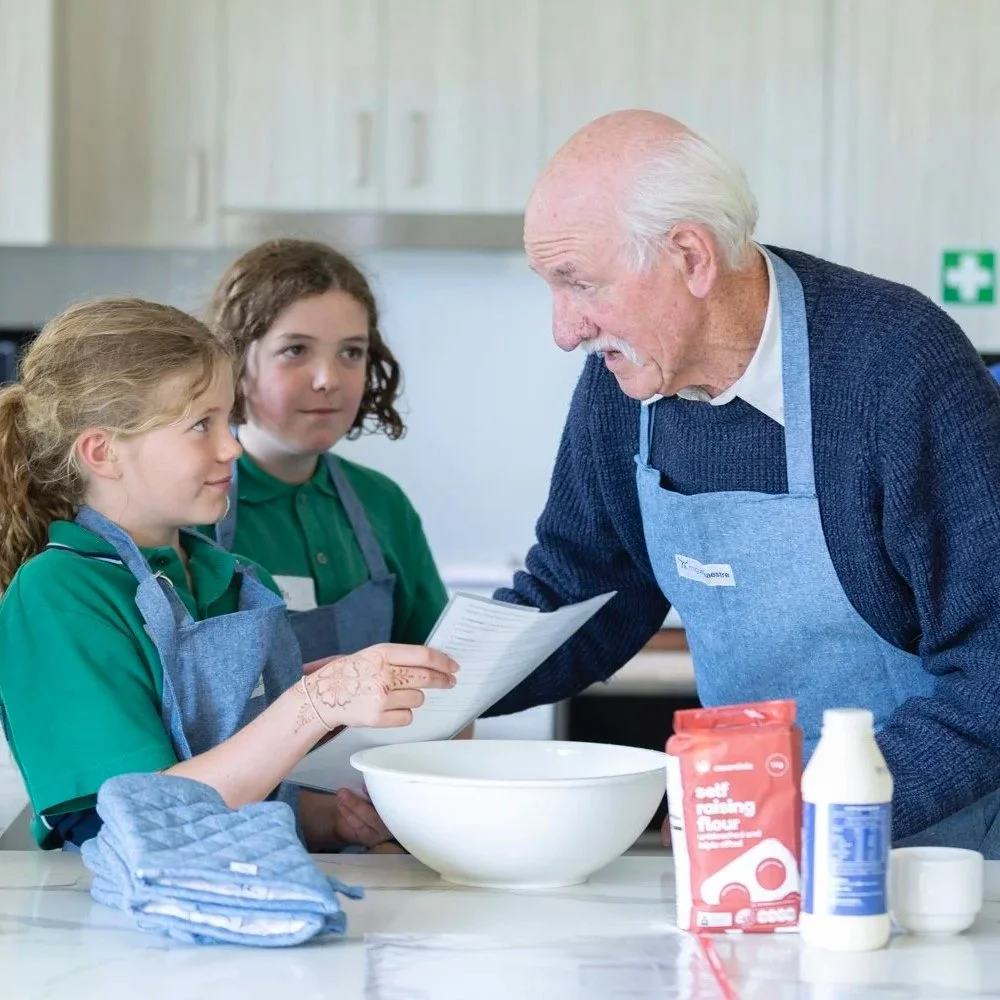
| 4. Shared activity | Simple collaborative task designed to prompt conversation without pressure. | AC9HP6M09, AC9HP6P05 |
| 5. Conversation support | Facilitators guide each pair with prompts and pacing. | AC9HP6P04, AC9HP6P06 |
| 6. Closing and transition | Group reflection; acknowledging each person’s skills. | AC9HP6P10, AC9HP6P01 |
State and Territory view
Every jurisdiction builds on the Australian Curriculum in its own way, so the same program is referenced slightly differently depending on the school’s location.
| State | Curriculum areas | Curriculum framework | Intergenerational Program links |
|---|---|---|---|
| VIC | Personal and Social Capability, English, Humanities, Health and Physical Education, Ethical and Intercultural Capabilities, Critical and Creative Thinking | Victorian Curriculum F–10 Version 2.0. Health and Physical Education: Personal, Social and Community Health – Health Education. | Supports empathy, social skills, storytelling, community contribution, history, wellbeing and creativity. |
| NSW | Personal and Social Capability, HSIE and Civics and Citizenship, English, PDHPE, Ethical Understanding | NSW Curriculum: PDHPE K–6 Syllabus (2024), Stage 3. Also see NESA. | Supports empathy, social skills, civic understanding, storytelling, wellbeing and collaboration. |
| QLD | Personal and Social Capability, Health and Physical Education, Humanities, English, Ethical and Intercultural Capabilities | QCAA: Australian Curriculum v9.0. Uses the AC9HP6 codes listed above. | Supports wellbeing, social skills, ethical understanding, critical thinking, storytelling and community history. |
| SA | Personal and Social Capability, Community Engagement, Humanities, English, Health and Wellbeing | South Australian Curriculum | Supports community engagement, empathy, social development, wellbeing and reflective learning. |
| WA | Personal and Social Capability, Humanities, The Arts, English, Health and Physical Education, Critical and Creative Thinking | SCSA: Western Australian Curriculum K–10 Outline | Supports empathy, wellbeing, creative collaboration, social skills and historical understanding. |
| TAS | Community Service Learning, Health, Humanities, English, Personal and Social Capability | Tasmanian Department for Education, Children and Young People: Curriculum. Prep to Year 10 uses Australian Curriculum v9.0, so the AC9HP6 codes listed above apply. | Supports community service, empathy, social connection, reflective learning and storytelling. |
| ACT | Australian Curriculum general capabilities (Personal and Social, Ethical, Intercultural, Critical and Creative Thinking), English, Humanities, Health and Physical Education | ACT Education Directorate: Curriculum and Academic Reporting Policy. Kindergarten to Year 10 uses Australian Curriculum v9.0, so the AC9HP6 codes listed above apply. | Supports empathy, social skills, community participation, reflective thinking and storytelling. |
| NT | Australian Curriculum general capabilities plus local priorities (Personal and Social, Ethical, Intercultural, Critical and Creative Thinking), Health, Humanities, English | NT Curriculum: Australian Curriculum v9.0. Uses the AC9HP6 codes listed above. | Supports empathy, social skills, cultural understanding, community engagement and wellbeing. |
Beyond Health and Physical Education. The program also supports the Personal and Social, Ethical Understanding and Intercultural Understanding Capabilities; English (oral storytelling and listening); The Arts; Technologies (the shared bridge task); and HASS (oral-history style inquiry).
Australian Curriculum codes are from ACARA’s published v9.0 sequence. Sources: Australian Curriculum v9.0 © ACARA, CC BY 4.0, via QCAA’s sequence of content descriptions; VCAA, NESA, Queensland Department of Education, ACARA implementation pages.